Introduction
Table of Contents
ToggleLow competition keywords are keywords selected through keyword research using free methods and tools such as Google Keyword Planner, the free version of Ubersuggest, or paid tools like SEMrush and Ahrefs.
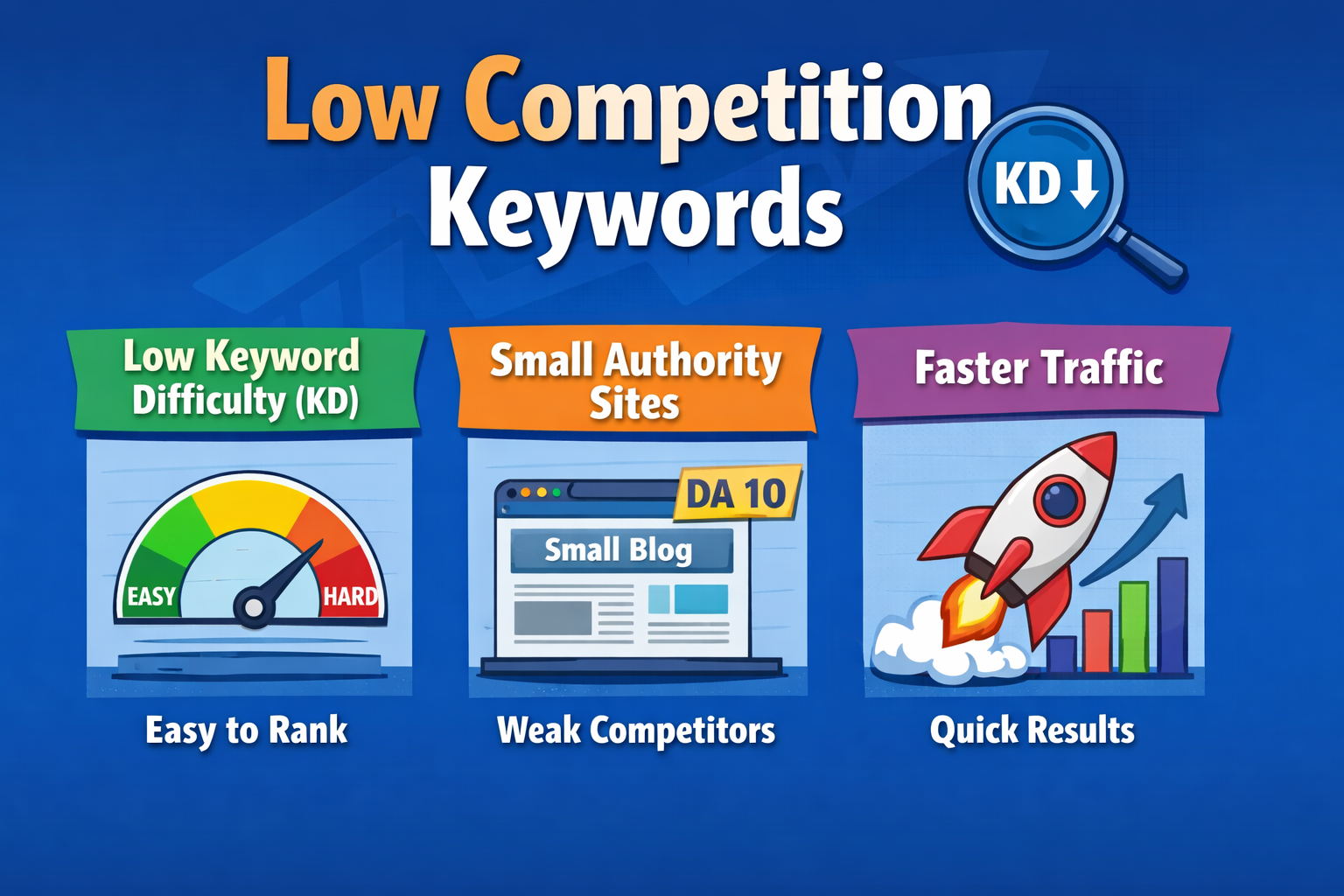
Low competition keywords are search terms whose competition level or keyword difficulty (KD) score is low, which makes them easier to rank in search engines.
Beginners should focus on low competition keywords because high competition keywords are very difficult to rank for. Most high-competition keywords are already dominated by websites with high Domain Authority (DA), and it is very hard for new or small websites to compete with them.
On the other hand, low competition keywords are easier to rank because their keyword difficulty is lower, and often smaller websites with low Domain Authority are already ranking for them. This gives beginners a better chance to appear in search results and start getting traffic.

What Are Low Competition Keywords?
Low competition keywords are search terms identified during the keyword research process that are easier to rank for, especially for beginners. When optimizing a website, we usually choose keywords that give us a realistic chance of ranking in search engines.
These keywords typically have low competition or a low keyword difficulty (KD) score, meaning fewer strong websites are targeting them. In many cases, the websites currently ranking for these keywords have lower Domain Authority (DA), which makes it easier for new or smaller websites to compete.
By doing proper competitor analysis and creating better, more helpful content with strong SEO optimization, beginners can rank for these low competition keywords more easily.
Competition vs Search Volume
When doing keyword research, two important factors to consider are competition (or keyword difficulty) and search volume.
Competition
Competition refers to how difficult it is to rank for a particular keyword. If many strong websites with high Domain Authority (DA) are targeting the same keyword, the competition will be high. Keywords with low competition or low keyword difficulty (KD) are called low competition keywords, and they are easier to rank for.
Search Volume
Search volume refers to how many times a keyword is searched in search engines within a given time period (usually per month). A higher search volume means more people are searching for that keyword.
Important Balance
For beginners, it is better to choose keywords that have:
Low competition
Decent or moderate search volume
Choosing only high search volume keywords without checking competition can make ranking very difficult. The smart strategy is to find keywords that have manageable competition and enough searches to bring traffic.
.
Why Low Competition Keywords Are Important for Beginners
Low competition keywords are very important for beginners because they give new websites a realistic chance to rank and grow.
1️⃣ Easier to Rank
Low competition keywords are easier to rank for because the websites currently ranking for them often have lower Domain Authority (DA) or are beginner-level sites.
2️⃣ Faster Traffic Growth
Since these keywords are easier to rank, your page can reach higher positions more quickly and start bringing organic traffic faster.
3️⃣ Helps Build Website Authority
When your content ranks and starts getting traffic consistently, it builds trust with users and search engines. Over time, this helps strengthen your website’s authority.
How to Find Low Competition Keywords (Step-by-Step)
Step 1: Use Google Autocomplete
Google Autocomplete shows keyword suggestions based on real user searches. These suggestions can help you find long-tail, low competition keywords.
Step 2: Check “People Also Ask”
The “People Also Ask” section shows common user questions. These question-based keywords often have lower competition and strong intent.
Step 3: Use Free Keyword Tools
You can use tools like:
Ubersuggest (free version)
Google Keyword Planner
AnswerThePublic
These tools help identify keywords with lower competition and reasonable search volume.
Step 4: Look at Weak Websites Ranking
If small blogs or low-authority websites are ranking on the first page, it is a good sign that the keyword competition is manageable.
What Is a Good Keyword Difficulty for Beginners?
Keyword difficulty (KD) shows how hard it is to rank for a keyword. For beginners, it is better to target keywords with very low KD, often in the 0–10 range (depending on the tool).
However, always check the actual search results. If smaller websites are ranking, you also have a chance with well-optimized content.
Common Mistakes Beginners Make in Keyword Research
1️⃣ Choosing keywords that don’t match website intent
2️⃣ Selecting keywords with high or moderate difficulty
3️⃣ Targeting highly competitive, high-volume keywords
4️⃣ Ignoring keywords that match website goals or conversions
Examples of Low Competition Keywords
Here’s a set of low competition keyword examples you can drop into that post, grouped by type so it doesn’t just read as a random list — each one explains why it’s low competition, not just that it is.
1. Long-tail question keywords
- “how to check keyword difficulty for free” instead of “keyword difficulty”
- “why is my blog not ranking after 6 months” instead of “blog not ranking”
Why low competition: specific questions have less search volume, so big sites don’t bother targeting them individually — but the person searching is often further along and more likely to engage.
2. “For X” audience-narrowed keywords
- “SEO tips for beginners in India” instead of “SEO tips”
- “keyword research for small blogs” instead of “keyword research”
Why: adding an audience segment cuts the competing pool down to sites that specifically address that segment — which is usually a much smaller list.
3. Comparison/decision keywords
- “Ahrefs vs free keyword tools for beginners”
- “Rank Math vs Yoast for a new WordPress blog”
Why: these have commercial intent but aren’t the “money keywords” (like “best SEO tool”) that everyone fights over — the buyer is closer to a decision but the term itself is overlooked.
4. Local/geo-modified keywords
- “SEO freelancers in Bhubaneswar”
- “digital marketing blogs from Odisha”
Why: geo-modifiers instantly shrink the competing set to local or hyper-relevant content — this is exactly the angle you already have working in your favor.
5. Problem + specific tool/context keywords
- “how to fix keyword cannibalization in WordPress”
- “Google Search Console showing impressions but no clicks”
Why: these describe a precise symptom someone is actively troubleshooting. High-authority sites usually write generic guides, not symptom-specific ones — so there’s a gap.
A line worth adding for your readers, since this is a beginner-focused blog: low competition doesn’t mean low value — it means fewer sites are worth beating to rank, which is exactly what a new blog needs first.
If you want, I can pull actual keyword-difficulty numbers or search volume for any of these using a live search so the post has real data instead of illustrative examples — want me to do that?
Conclusion
After reading this blog on low competition keywords in SEO, you should now understand why they are important, especially for beginners. Targeting low competition keywords makes it easier to rank in search engines and start getting organic traffic without competing directly with high-authority websites.
By choosing the right keywords, analyzing competition, and creating helpful, well-optimized content, beginners can gradually grow their website’s visibility and authority. Focusing on low competition keywords is one of the smartest strategies to build a strong SEO foundation.