Introduction
The title tag in SEO is one of the most important on-page elements that helps search engines and users understand what your webpage is about. It appears as the clickable headline in search engine results and plays a big role in attracting users to visit your page.
Even though Google does not always use the exact title you write, a well-optimized title tag improves click-through rate (CTR) and sends positive engagement signals. In this beginner’s guide, you’ll learn how to write a perfect title tag, the ideal length, examples of good vs bad title tags, and common mistakes to avoid.
What is a Title Tag in SEO?
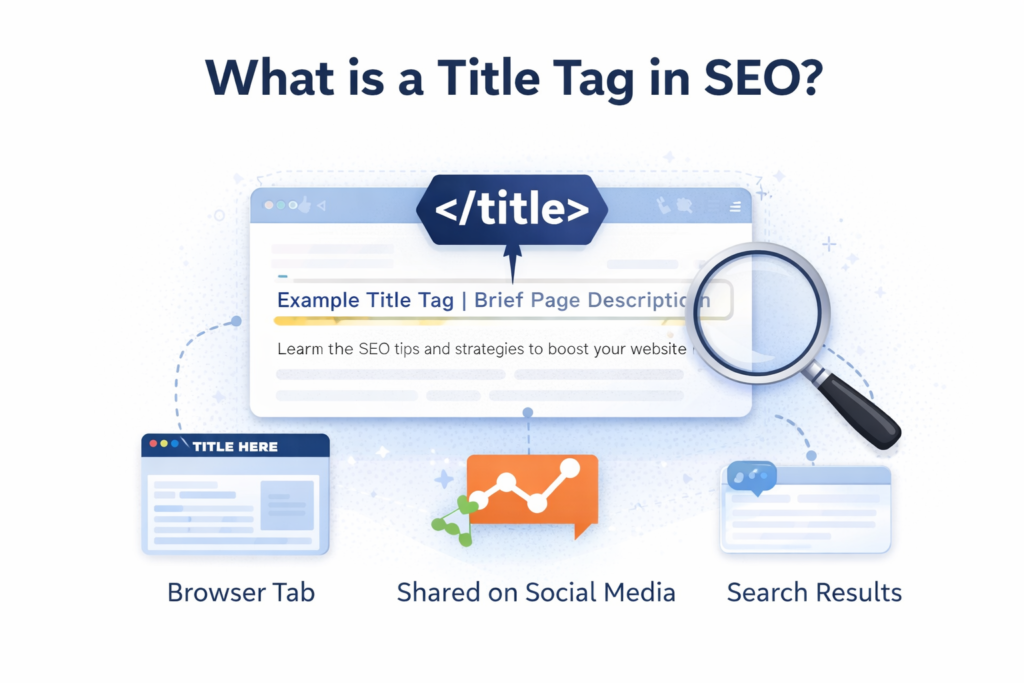
A title tag is an HTML element that defines the title of a webpage. It is shown:
-
In search engine results as the main headline
-
On browser tabs
-
When a page is shared on social media
It helps both users and search engines understand the page topic and intent.
Why is Title Tag Important for SEO?
The title tag is important because:
-
It improves click-through rate (CTR)
-
It tells search engines what your page is about
-
It helps match your page with search intent
-
A strong title attracts more visitors, which can indirectly support rankings
Without a proper title tag, your page may not clearly communicate its value in search results.
How to Write a Good Title Tag
A good title tag should:
-
Be clear and simple
-
Include the primary keyword naturally
-
Stay within 50–60 characters
-
Match the page content and intent
-
Be unique for every page
Example Format:
Primary Keyword | Secondary Keyword
Example:
Title Tag in SEO | Beginner Guide with Examples
Ideal Length of Title Tag
The ideal length of a title tag is 50–60 characters.
If it is too long, search engines may cut it off.
If it is too short, you may miss the chance to describe your page properly.
Good Title Tag vs Bad Title Tag
✅ Good Title Tag
A good title tag is:
-
Easy to read
-
Written naturally
-
Clearly explains the page topic
-
Uses keywords properly
Example:
Title Tag in SEO | Beginner Guide with Examples
❌ Bad Title Tag
A bad title tag usually:
-
Contains keyword stuffing
-
Is confusing or unnatural
-
Does not explain the page clearly
Example:
SEO Title Tag SEO Tips SEO Guide SEO
Common Mistakes in Title Tags
Here are mistakes people make while writing title tags:
-
Making the title complicated instead of simple
-
Stuffing too many keywords
-
Not separating phrases with a hyphen (-) or vertical bar (|)
-
Writing duplicate title tags on multiple pages
-
Writing titles that don’t match the actual page content
These mistakes make titles look spammy and reduce user clicks.
How Title Tags Affect Click-Through Rate (CTR)
One of the biggest benefits of writing a strong title tag in SEO is improving your click-through rate (CTR). CTR means how many people click on your page after seeing it in search results.
Even if your page ranks on the first page of Google, users will not click if the title is boring, unclear, or stuffed with keywords. A well-written title tag makes your result stand out and encourages users to choose your page over others.
A good title tag improves CTR by:
-
Clearly showing what the page is about
-
Matching the exact search intent of users
-
Using action or benefit-based words like Guide, Tips, Checklist, Examples
-
Creating curiosity without being misleading
For example, compare these two titles:
❌ SEO Title Tag Guide
✅ Title Tag in SEO: Beginner’s Guide with Examples
The second title is more specific and helpful, which increases the chance of getting clicks.
Higher CTR tells search engines that users find your page useful. Over time, this can positively influence your search performance.
Conclusion
After reading this guide on title tags in SEO, you should now understand how to write effective, clear, and keyword-focused titles — and what mistakes to avoid.
A well-written title tag improves your page’s visibility in search results and encourages more users to click. More clicks combined with useful content send positive signals to search engines, which can help improve rankings over time.
Take time to craft unique, simple, and natural title tags for every page — it’s a small step that makes a big difference in SEO.